


FCDO Apostille Certified Translation UK: Legalisation Office Guidelines 2026
In an interconnected international economy, cross-border legal transactions, overseas corporate expansions, foreign employment relocations, and international probate proceedings require individuals and corporate entities to establish the authenticity of domestic legal instruments across foreign sovereign jurisdictions. For official documents issued within the United Kingdom to be granted unconditional legal validity in a foreign country, they must undergo the rigorous legalisation process established under the 1961 Hague Apostille Convention. Administered exclusively by the Foreign, Commonwealth & Development Office (FCDO) Legalisation Office, this statutory authentication confirms the genuineness of the signature, seal, or stamp affixed to a public instrument. However, obtaining an apostille certificate on a UK public document is frequently only half the battle: foreign courts, ministries, municipal registrars, and corporate registries require an authorized, fully compliant FCDO apostille certified translation in the UK to enable lawful cross-border enforcement and administrative processing.
Understanding the FCDO Legalisation Framework and the 1961 Hague Convention
The Hague Convention of 5 October 1961 Abolishing the Requirement of Legalisation for Foreign Public Documents—commonly known as the Hague Apostille Convention—fundamentally transformed international private law. Prior to this landmark treaty, validating a domestic public document for use in a foreign jurisdiction required a cumbersome, multi-layered chain of consular authentications involving domestic ministries of foreign affairs, foreign embassies, and local municipal authorities.
Under the modern Apostille Convention, member states agree to waive traditional diplomatic and consular legalisation requirements, replacing them with a standardized, sequentially numbered certificate known as an Apostille. In the United Kingdom, the sole official competent authority empowered by His Majesty's Government to issue apostilles is the Legalisation Office of the Foreign, Commonwealth & Development Office (FCDO), located in Milton Keynes and London.
When an apostille is affixed to a public document—such as a General Register Office (GRO) birth certificate, a Companies House certificate of incorporation, an academic diploma, or a notarized power of attorney—it legally certifies:
- The authenticity of the signature of the public official or notary who executed or certified the document.
- The capacity in which the signatory acted (e.g., Registrar, Notary Public, Solicitor, or Consular Officer).
- The identity of any official stamp or seal affixed to the underlying instrument.
However, because the UK FCDO Apostille is drafted in English (with French language treaty headers), foreign recipient authorities in non-English speaking jurisdictions—including Spain, France, Italy, Germany, China, Brazil, and the Middle East—require an official certified translation of both the underlying UK public document and the newly issued FCDO apostille certificate itself before the instrument can be registered or submitted in court.
The Two Critical Pathways: Translating Before vs Translating After FCDO Apostille
One of the most consequential strategic decisions faced by legal professionals, corporate executives, and private individuals is establishing the correct procedural sequence for certified translation and apostille execution. Depending on the precise statutory demands of the foreign recipient jurisdiction, two distinct procedural pathways exist:
Pathway 1: Legalising the Underlying UK Document First, Then Translating Both Document and Apostille (Standard International Route)
In the vast majority of cross-border scenarios—including immigration applications, foreign property acquisitions, and dual citizenship petitions in European Union member states and Latin America—the foreign authority insists that the underlying UK document must be apostilled first. The procedure unfolds as follows:
- The original UK public document (or a certified copy executed by a registered UK Notary Public or Solicitor) is submitted to the FCDO Legalisation Office in Milton Keynes.
- The FCDO attaches the physical, embossed, and adhesive Apostille certificate to the reverse of the UK document, binding the pages with security rivets or tamper-evident seals.
- The consolidated document packet—consisting of the underlying UK instrument, the notarial jurat, and the newly affixed FCDO Apostille—is submitted to an accredited UK certified translation organization such as Lang247.
- The certified translator executes an unabridged, word-for-word translation into the target language, translating the complete text of the UK document, the notary's declaration, and the complete 10-point text of the FCDO Apostille.
- The translation is issued with a formal Statement of Truth, accredited translator credentials, and official corporate seals, ready for immediate presentation to the foreign authority.
Pathway 2: Translating the UK Document First, Notarising the Translation, and Apostilling the Translator's Certification (Direct Legalisation Route)
In certain strict civil law jurisdictions (including specific probate courts in Italy, Greece, and Eastern Europe), foreign judicial authorities refuse to accept foreign-executed certified translations unless the translator's own certification has undergone statutory UK notarisation and direct FCDO apostille legalisation. In this pathway:
- The original UK document is translated into the foreign language by an accredited professional translator.
- The translator attends before a registered UK Notary Public, produces proof of linguistic competence, and executes a formal Sworn Declaration (Affidavit of Translation Accuracy) under oath.
- The Notary Public attests the translator's signature, applies the official notarial seal, and signs the jurat.
- The combined translation packet is submitted to the FCDO Legalisation Office, where an FCDO Apostille is affixed directly to the Notary Public's signature, confirming the legal standing of the notarial execution.
Failing to establish which of these two procedural sequences your foreign recipient authority demands can result in rejected legal filings, severe commercial delays, and unnecessary re-legalisation expenses.
Legal Framework: The Statutory Declarations Act 1835 and Notarial Execution
Understanding the statutory foundation of UK legalisation requires examining the intersection between English common law and civil law notarial traditions. Unlike solicitors, whose authority is primarily domestic and regulated by the Solicitors Regulation Authority (SRA), Notaries Public in England and Wales are appointed by the Faculty Office of the Archbishop of Canterbury under ancient statutory charters and modern public legislation.
A Notary Public acts as an independent officer of international private law. When a document is notarized in the UK for overseas use, the Notary executes a formal Jurat or Public Form Certificate. Under the Statutory Declarations Act 1835, when an accredited translator swears an affidavit confirming that their translation into Spanish, French, Italian, or German is an exact and faithful reproduction of the underlying UK instrument, the declaration takes on solemn statutory weight. Making a false declaration under this Act constitutes a criminal offense under the Perjury Act 1911.
Because the FCDO Legalisation Office maintains an active verification database containing the specimen signatures, seals, and practicing certificates of all registered Notaries Public and Solicitors, the Apostille certificate directly validates this solemn statutory chain. Caseworkers and foreign consular officers rely on this rigorous evidentiary foundation to prevent international identity fraud and corporate deception.
Core Document Categories Requiring FCDO Apostille and Certified Translation
The FCDO Legalisation Office handles hundreds of thousands of documents annually across diverse personal, corporate, and academic spheres. The table below details the most common document classifications and their standard legalisation and translation requirements:
| Document Classification | Representative UK Documents | Prerequisite UK Certification | FCDO Apostille Eligibility | Certified Translation Scope |
|---|---|---|---|---|
| Vital Statistics & Civil Status | Birth, Marriage, Civil Partnership, Death, and Adoption Certificates. | Must be official certified copies issued by General Register Office (GRO) or local registrar. No solicitor certification needed. | Directly eligible for FCDO apostille based on registered registrar signatures. | Full translation of all registry entries, marginal notes, watermarked borders, and FCDO apostille seal. |
| Academic & Educational Credentials | University Degree Diplomas, Academic Transcripts, GCSE / A-Level Certificates, TEFL Awards. | Must be certified as true copies of original records by a UK Notary Public or Solicitor who has verified authenticity with the awarding institution. | Eligible once certified by a registered Notary or Solicitor whose signature is on the FCDO database. | Complete translation of degree honors, credit hours, Latin mottoes, university seals, notarial certification, and apostille text. |
| Corporate & Commercial Records | Certificates of Incorporation, Articles of Association, Good Standing Certificates, Board Resolutions. | Direct certified copies from Companies House, or notarized executions for company powers of attorney and board minutes. | Directly eligible if signed by Companies House officer, or via registered Notary signature. | Unabridged translation of corporate governance clauses, share capital allocations, director signatures, and apostille details. |
| Legal & Judicial Filings | Grants of Probate, Letters of Administration, Court Judgements, Decrees Absolute, Affidavits. | Must bear the original seal or stamp of the High Court of Justice, Family Court, or County Court, or be sworn before a Notary. | Directly eligible via court seal verification or notarial signature check. | Word-for-word translation of judicial decrees, statutory citations, court seal legends, and apostille security numbers. |
| Police Records & Background Checks | ACRO Police Certificates, Disclosure and Barring Service (DBS) checks, NPCC clearances. | ACRO certificates are directly eligible if bearing official official signatures; DBS certificates require prior solicitor/notary certification. | Eligible upon signature verification by the Legalisation Office. | Rigorous translation of criminal clearance statements, statutory rehabilitation notes, official seals, and apostille. |
FCDO Legalisation Office Statutory Submission Requirements (2026 Standards)
To successfully legalise a UK document through the FCDO Legalisation Office, applicants must comply with strict operational rules established by the UK Government:
FCDO Legalisation Statutory Standards (2026)
- Registered Signatory Database Verification: Every solicitor, notary public, registrar, or public official whose signature appears on a UK document must have their official signature, seal specimen, and practicing certificate registered with the FCDO Legalisation Office. If a newly qualified solicitor certifies a document without prior FCDO registration, the apostille application will be rejected immediately.
- Physical Document Integrity: Documents submitted for postal or premium legalisation must not be laminated, damaged, or defaced. If a document consists of multiple pages, it must be securely bound with an official grommet, legal corner, or sewn ribbon sealed by the certifying notary.
- Originals vs Certified Copies: Certain public records—such as GRO marriage certificates, police ACRO certificates, and probate grants—must be submitted as official originals or court-sealed exemplars. Other documents, such as academic transcripts and corporate contracts, must be certified true copies executed in strict accordance with the Solicitors Regulation Authority (SRA) or Faculty Office notarial rules.
- Processing Channel Options: Applicants can submit via the FCDO Standard Postal Service (processed at the Milton Keynes facility in 5 to 10 working days) or via the FCDO Business / Premium Service (processed in London within 24 hours for registered commercial legalisation agents).
Electronic e-Apostilles vs Paper Apostilles: The 2026 Modernization
In response to international digitalization initiatives under the Hague Conference on Private International Law (HCCH), the FCDO operates an Electronic Apostille (e-Apostille) service alongside traditional paper legalisation. Understanding when an e-Apostille is permissible and how it affects certified translation is critical:
When Can an e-Apostille Be Issued?
An e-Apostille is available exclusively for documents that have been issued electronically with a verifiable cryptographic Qualified Electronic Signature (QES) or certified by a UK Notary Public or Solicitor using an advanced digital signature conforming to eIDAS standards. Documents eligible for e-Apostille include:
- Electronic Companies House documents downloaded directly from the official register.
- Notarized powers of attorney signed with digital certificates.
- Court judgments issued in electronic PDF format with digital judicial seals.
- Educational degrees where the university registrar provides an electronically certified transcript.
Evidentiary Limitations of e-Apostilles
Despite the speed of e-Apostilles (often issued within 24 hours), physical paper documents—such as GRO birth, marriage, and death certificates, and ACRO police certificates—cannot receive an e-Apostille and must be legalised with a physical paper apostille. Furthermore, many overseas civil registries (notably in southern Europe and Latin America) still mandate wet-ink stamped apostilles and will refuse electronic PDF apostilles. Before choosing the e-Apostille route, always confirm with the foreign recipient authority whether electronic legalisation is recognized in their domestic registry.
Country-Specific Cross-Border Case Studies
To demonstrate the operational realities of FCDO apostille certified translation, examine these three representative international workflows:
Case Study 1: Spanish Golden Visa & Property Purchase (Spain / Latin America)
The Scenario: A UK resident bought a residential property in Marbella, Spain, and applied for the Spanish Investor Residence Visa. The Spanish immigration consulate in London and the land registrar in Marbella demanded the applicant's UK ACRO Police Certificate, marriage certificate, and bank statements.
The Legalisation Requirement: Spain is a member of the Hague Apostille Convention. Under Spanish administrative law, foreign documents must bear the Hague Apostille and must be accompanied by an official translation into Castilian Spanish executed by a sworn translator (Traductor Jurado) registered with the Spanish Ministry of Foreign Affairs (MAEC) or an accredited UK translation body with a certified statement.
The Execution: Lang247 managed the FCDO apostille legalisation of the original ACRO certificate and GRO marriage certificate, then performed the official certified Spanish translation including the full 10-point text of the apostille. Both documents were accepted immediately by the Spanish Consulate in London.
Case Study 2: Italian Dual Citizenship by Descent (Jure Sanguinis)
The Scenario: A British citizen applied for Italian citizenship by descent through their Italian grandfather at the Italian Consulate in London. The required dossier included UK birth, marriage, and death certificates across three generations.
The Legalisation Requirement: The Italian Ministry of the Interior strictly enforces the Apostille Convention. Every UK vital record issued by the General Register Office had to be legalised with an FCDO Apostille. Italian consular authorities also require that the certified translation into Italian must be fully aligned with historic Italian vital records, ensuring that anglicized ancestral names are legally cross-referenced.
The Execution: Lang247 secured FCDO apostilles across all seven family certificates, executed sworn Italian certified translations with full genealogical precision, and prepared the consular dossier, leading to seamless recognition of Italian citizenship.
Case Study 3: UAE Corporate Subsidiary Setup (Dubai Mainland DET)
The Scenario: A London-based financial technology company expanded into the United Arab Emirates, establishing a wholly owned subsidiary registered with the Dubai Department of Economy and Tourism (DET). The corporate registry required the UK Certificate of Incorporation, Memorandum & Articles of Association, and a Board Resolution appointing the Dubai General Manager.
The Legalisation Requirement: Because the UAE is not a party to the 1961 Hague Apostille Convention, an FCDO apostille alone is insufficient. The document package required full consular attestation: UK Notary certification → FCDO legalisation → UAE Embassy London attestation → UAE MOFA attestation in Dubai → Ministry of Justice (MOJ) certified Arabic legal translation.
The Execution: Lang247 handled the complete UK and UAE pipeline, securing notarial seals, FCDO apostilles, UAE Embassy stamps in London, and delivering sworn MOJ Arabic legal translations in Dubai. The corporate trade license was issued without delay.
The Anatomy of an FCDO Apostille Certificate
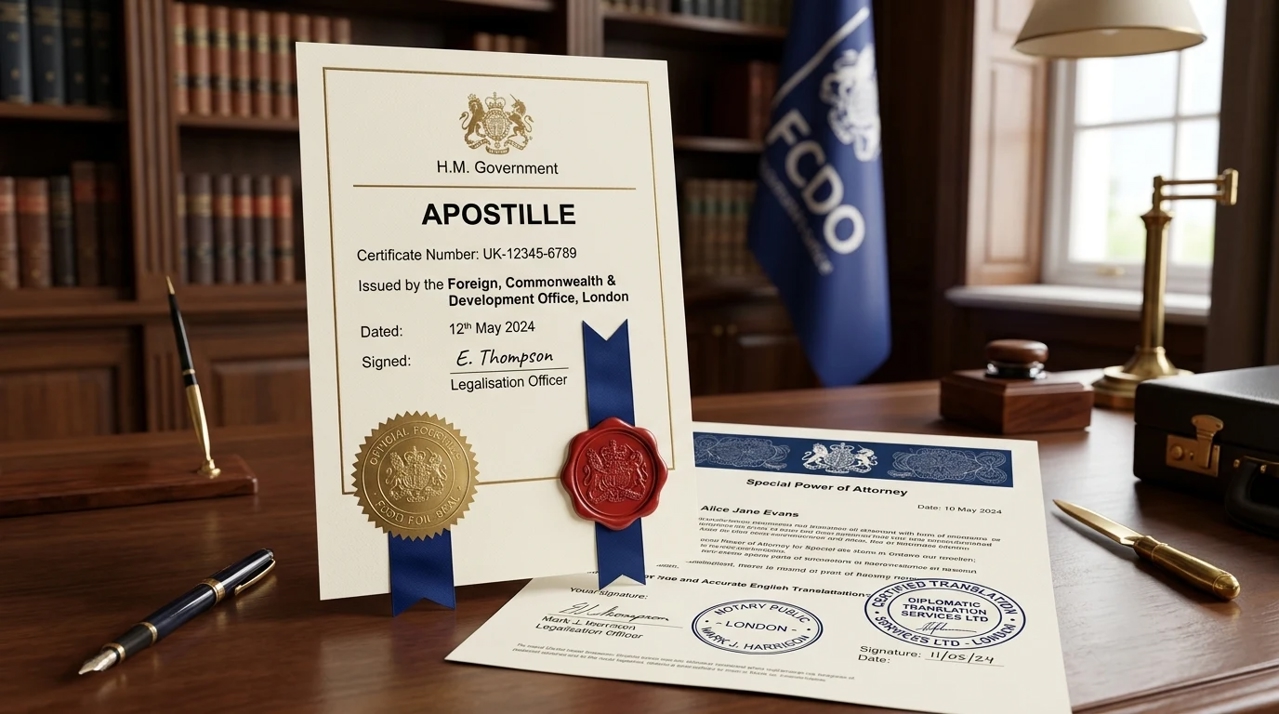
The FCDO Apostille is a standardized paper certificate printed in accordance with the 1961 Hague Convention format. When a certified translator translates an apostille certificate for foreign submission, they must accurately reproduce each of the ten numbered standardized fields:
- Country (Pays): United Kingdom of Great Britain and Northern Ireland.
- Signatory Name: The full legal name of the public official, notary, registrar, or solicitor who signed the underlying document.
- Acting in the Capacity of: The official statutory title of the signatory (e.g., "Notary Public", "Registrar of Births, Deaths and Marriages", "Officer of HM Courts & Tribunals Service").
- Bears the Seal / Stamp of: The identification of the official seal or stamp affixed to the underlying document.
- Place of Issue (At): London or Milton Keynes.
- Date of Issue (The): The exact calendar date on which the apostille was executed by the FCDO.
- Issuing Authority (By): His Majesty's Principal Secretary of State for Foreign, Commonwealth and Development Affairs.
- Apostille Certificate Number: The unique alphanumeric tracking and verification number (e.g., APOSTILLE UK-12345678).
- Seal / Stamp: The official blind embossed or ink-printed seal of the FCDO Legalisation Office.
- Signature: The signature of the authorized FCDO legalisation officer.
Every professional certified translation produced by Lang247 faithfully reproduces these ten elements in the exact layout mandated by foreign judicial and administrative authorities, ensuring immediate acceptance without queries.
Non-Hague Convention Jurisdictions: The Multi-Stage Consular Attestation Chain
While over 120 nations are signatories to the Hague Apostille Convention, many prominent global jurisdictions—including the United Arab Emirates, Qatar, Kuwait, Egypt, Vietnam, and Thailand—have not ratified the treaty. When preparing UK public documents for use in these non-Hague territories, the procedural requirements expand into an intricate multi-stage consular attestation pipeline:
- Stage 1 (UK Notarisation): The document is certified by an authorized UK Notary Public.
- Stage 2 (FCDO Legalisation): The document is submitted to the FCDO Legalisation Office, which affixes an official apostille certificate confirming the Notary's authority.
- Stage 3 (Consular Attestation at Foreign Embassy in London): The apostilled document is submitted to the London embassy or consular mission of the destination country (e.g., the UAE Embassy in London), where a consular attestation stamp and fee voucher are affixed.
- Stage 4 (In-Country Ministry of Foreign Affairs Attestation): Upon arrival in the destination country, the document is submitted to the local Ministry of Foreign Affairs (such as MOFA in Dubai or Abu Dhabi) for final statutory legalization.
- Stage 5 (In-Country Ministry of Justice Legal Translation): The fully attested document packet is translated into the official domestic language (such as Arabic in the UAE) by a sworn legal translator licensed by the local Ministry of Justice.
Frequently Asked Questions Regarding FCDO Apostille Certified Translations
Does the FCDO Legalisation Office translate documents directly?
No. The UK Foreign, Commonwealth & Development Office Legalisation Office only validates the signatures, seals, and authority of public officials and notaries on UK documents. It does not provide translation services. Translations must be executed by an independent accredited certified translation provider such as Lang247.
Can I translate my document into English and get an apostille on the translation?
Yes. If you possess a foreign document that has been translated into English in the UK, the translator can swear an Affidavit of Accuracy before a UK Notary Public. The FCDO will then apostille the Notary's signature, confirming the legal standing of the notarial execution.
Why do foreign authorities reject translations that do not include the apostille certificate?
When an apostille is affixed to a document, the apostille certificate becomes an inseparable, legally binding part of that instrument. Foreign administrative authorities and courts require a complete, unabridged translation of the entire legal instrument—including the apostille—so they can verify the issuing official's capacity and the unique certificate number in their domestic language.
What is the difference between a certified translation and a notarized translation?
A certified translation is executed by an accredited professional translator or corporate member of a recognized linguistic association (such as ITI, CIOL, or ATC) who issues a signed Statement of Truth. A notarized translation goes one step further: the translator appears in person before a UK Notary Public to swear an oath confirming the accuracy of the translation, and the Notary affixes their formal notarial seal and jurat.
Can electronic e-Apostilles be translated and certified?
Yes. The FCDO now issues electronic Apostilles (e-Apostilles) for certain digitally signed UK documents. Certified translators can review the cryptographically secured PDF e-Apostille, verify the digital signature, and produce a fully compliant certified translation that cross-references the digital certificate number.
How quickly can an FCDO apostille and certified translation be completed?
Standard postal FCDO legalisation typically takes 5 to 10 working days, followed by 24 to 48 hours for certified translation. However, using Lang247's expedited legalisation and translation service, documents can be submitted via the London FCDO Premium counter and translated on a same-day or 24-hour turnaround.
Does an FCDO Apostille expire?
An FCDO Apostille certificate itself does not have an expiration date. However, foreign recipient authorities frequently impose strict validity windows on underlying documents—for instance, requiring criminal background checks or civil status certificates to be issued and apostilled within 3 to 6 months of submission.
Can I remove the apostille certificate and reattach it to another copy?
No. Tampering with, unfastening, or reattaching an FCDO Apostille certificate completely invalidates the legalisation. The apostille is bound with security eyelets or tamper-proof adhesive seals. If the seal is compromised, foreign border officials and registries will reject the document as fraudulent.
Guaranteed FCDO Legalisation & Certified Translation Support with Lang247
Navigating the complex interface between UK public law, the FCDO Legalisation Office, and foreign judicial translation mandates requires absolute technical precision. At Lang247, our specialized legalisation and translation team provides end-to-end management of your cross-border document needs. From solicitor and notarial execution to FCDO Apostille lodgement and accredited sworn translation into over 150 languages, we ensure that your vital records, corporate charters, and court orders achieve immediate, frictionless recognition worldwide. Contact our London office today to streamline your international document legalisation and translation pipeline.